Sunday, March 24, 2013

Kurokawa Onsen

As I mentioned previously, I had booked a night in a traditional Japanese inn in a little hot spring village up in the northern part of the island. Because I had been too sick to travel on the day Ed and I were supposed to go, and because they were fully booked the rest of the time he was in Japan, I had to reschedule the reservation for a later date. It was too late to get a refund. Luckily, one of my Japanese friends at school likes hot springs (onsens) a lot and said she could go with me instead.

The name of the village is Kurokawa Onsen, which means Black River Hot Spring. Although there are other resort towns in Japan and specifically Kyushu, this is one of the better ones, because there is an understanding (or maybe legislation) there that prevents things like giant concrete hotels, billboards and neon signs, and even convenience stores. Everything in the area is in the same quaint style, made of stone or wood. The purpose of the village is to enjoy the natural hot springs that the inns are built around. This area is especially good because most of them also have rotenburo, outdoor hot spring baths. The best time to enjoy rotenburo is during the winter, because you can enjoy being outside and seeing a nice view, but not be too hot, as you would be in summer. The hot springs are really, really hot, hotter than a hot tub, so it works well with freezing temperatures.

Here are some photos I took of the village.


This is a little public foot spa, where you can just take a break and stick your feet in a little hot spring river for free, but it was closed, with no water running through.


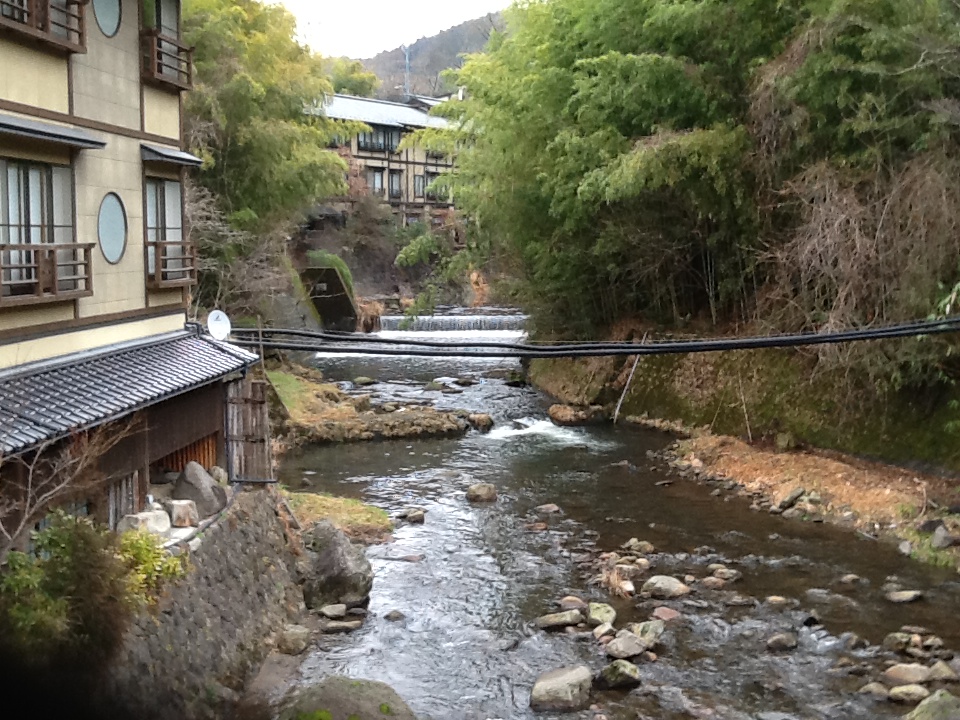
Here's the little Black River that runs through the village. Most of the inns are situated along it or near it.


The village is so small they don't get a full police station.


There are more than 20 inns in Kurokawa Onsen, maybe about 30, all of which have a few onsens, and most of which have at least one rotenburo. You get free access to any baths that your own inn has, but the big draw here is that you can get a special pass called a tegata, made out of a tree cookie, that allows you access to three different baths for 1200 yen. Alternatively, each bath costs 500 yen. The tegata is popular because people like to see a few different baths to really get the most out of staying in this area. It's really expensive. Also, the baths are so hot that you shouldn't and can't really stay in most of them for more than 10-20 minutes, and walking to the next one gives you a chance to cool off so you can go again. Even in the depth of winter, people walk outside from hotel to hotel in just their yukata (a thin kimono) and sandals, because the onsen heats you right to the core and gets you sweating.

Here is my tegata. The white strip is where three stickers used to be. With each place I went to, they removed one sticker and put their hotel stamp on the cookie.


Misaki and I arrived at our inn around 2:00, an hour before check in. However, they let us check in early because it was the slow season, and they weren't full enough to warrant making us wait. I took some photos of our room.

This table is called a kotatsu, which I learned about from my students. It's a special two-layer table with an electric blanket set between the layers. It's pretty much the only way some Japanese people keep warm. Apparently the tradition is to sit at this thing with family or friends and eat oranges. I don't know why. Underneath this particular kotatsu is a hole in the floor where you can put your legs, like sitting at a regular table. I don't imagine it's set up that way in the home, though.


Wall scroll--much more expensive in Japan than in Korea, unfortunately.


Even though it's supposed to be traditional, we still had TV. I can't imagine anyone turning on a TV when you have all this other stuff to do, not to mention the views out the window.


Here are the famous rice-paper sliding doors that Homer Simpson crashes through in that one episode.

Our armoire was filled with little goodies like towels, socks you can wear with sandals, and maybe some toiletries.


As in every Japanese housing establishment, there is an electric kettle and a box of tea and tea accessories.


Our entrance had a little kitty on the wall and maybe a little shrine??


Here's the main room as a whole. If you notice there are no beds, it's because there are no beds. In this type of place, while you are away eating dinner, gnomes move the table off to the side and put out futons on the floor.


Sink area with lots of free toiletries.


Japanese style washlet, as it's called here, with three types of bidet functions.


Possibly humorous wall hanging for toilet.


There's no shower or bath in any of the rooms, of course, because the whole purpose of the place is to use the onsens. They have shower facilities by all the indoor and most of the outdoor baths, so that's where you would go to wash.

Here's the front of our room. The rooms aren't numbered, apparently, but named. Ours was called rindou (pronounced sort of like "leendoe"), which is a type of flower--gentian in English. I never heard of that flower.


Here are some views from our window.


Here are some shots of the hotel interior. It was pretty big, multi-building.


These are all little gods, I think.


This is a little study where you can read a book or something and get some free coffee. I got us some coffee at one point, but it was terrible. I was extremely pissed off about that, since the room cost almost $200 per person per night. Surely they could afford better quality coffee.


The main building and the branch buildings were separated by the river, so we had to go across this little bridge.


 This is a bit of decor by one of the reception areas. From afar it just looks like a big turd, but up close you can see it's a bunch of horses.


I imagine they do something pretty fun at this table.


Here's the lobby in the building we stayed in.


With some views.


All around the grounds, along the river precipice, were little touches of quaint stuff, like this little spring. Sometimes these kinds of springs are meant to drink from, but I think this particular one was hot. I think I saw some eggs cooking in it the morning we left. That's common.


Here was our inn's own little foot spa, but we didn't bother to use it, since we had full body baths everywhere.


The ubiquitous Japanese koi pond.


This is the reception area for the main building. It seemed like a nice little place to hang out. If I were rich I would have stayed at this place a few days and chilled out on the grounds more.


There was a little model of like a traditional kitchen in there, too.


Later, the fire was going.


 I've been working my way out backwards from my room to the main entrance, so we're back outside again.


This inn was special, too, because they welcomed pets. This little building near the entrance is a special dog onsen. No joke. You can see on the sign a dog bathing in the water.


Here's the inside. It was empty, so I guess they don't fill it up unless they have guests with dogs.


Here's the main gate, Yamabiko Ryokan on the sign.


Anyway, we had the whole afternoon to enjoy the hot springs at the other ryokan, so we bought a tegata from our place, chose three places we wanted to go from the brochure, and set off.

The first place we went to was at Ryokan Yumotosou, which had a rotenburo surrounded by a bamboo grove. It was very peaceful. This is a picture from the internets. Because it was the off-season, we didn't have to share with many people. All the baths we went to, by the way, were gender segregated, so there would always be at least one bath for men and one for women. However, gender segregation while bathing was something those dirty Christians (literally, as they thought bathing too much was unhealthy) introduced into Japan a few hundred years ago. Traditionally, men and women bathed together, as it's a natural, nonsexual thing to do, and there are still some mixed gender places you can go to--such as at several inns in Kurokawa.


The second place we went to was a bath that was voted in the top 100 onsens in Japan (Japan has thousands, so it's a big deal). It was a rotenburo at Ikoi Ryokan, which is unusual because the back part of the bath is deep enough that you have to stand--it was about shoulder height on me. There are two large bamboo trunks hung parallel across the top of the water by ropes, and you can hang on to them and do like water acrobatics if you want. Or you can just throw your arms over one, rest your head on it, and relax. Here's another internetto picture.


After this one, I was pretty hungry, so we took advantage of some of the ¥50 hot spring eggs outside the ryokan.


Right in the entrance area was this little building where you can sit down for a while.


On the left side was a foot spa with a table.


We sat on the right side, where there was a little room just like that model in the picture above. A dude came and started a fire in the center for us, and there was a big iron teapot hanging above it, which they still use to make tea. It was pretty cool, although I hate tea.


 Then I had a nice cold drink from the spring. At these springs, there is always a little copper? cup on a stick, which everyone uses. It's pretty unsanitary, but they seem less concerned about sharing with strangers than we do. Since it's Japan, that cup probably does get washed at least once daily, too. They clean everything.


The third ryokan we went to was called Kiyashiki. This one was a bit out of the way, and we had to walk about twenty minutes or so, and up some big hills to get there. I liked this place the best, though. It had some streams of water coming down, so I was able to use them to massage my neck and back.


So after we finished using our tegatas, it was almost time for supper. Japanese traditional hotels like minshuku and ryokan often either include no meals or two meals--since the food at places like this is supposed to be really good, I went with the two meal option, which I think actually ends up being almost half the cost of the total bill. By the time it was time to eat, I was starving, so the food ended up being even better than it normally would have.

In a lot of ryokan, you get served your meals in your room. I would have really liked that, but I think maybe part of the reason this hotel was slightly cheaper than the other ones (as if) was that you don't get that benefit. We had to go to the main building to an area off the lobby to eat. However, each room does get its own private dining room, which is nice. Here's our rindou dining room.


Our meal consisted of several courses, laid out here on my own special menu. Unfortunately, I can't read it yet.


This was the first course. It's a big soup in the middle, and the black thing is a little barbecue to cook the little slices of beef and veggies on.


This is a specialty of the area--horse sashimi, raw horse meat. I really liked it, despite that I don't really like fish sashimi. But again, I was starving, so who knows how I'd feel about it now.


Pretty much everything in a meal like this can be eaten in one or two bites, which is good for picky eaters, since you don't have to deal with it for long.


The thing in the bowl is one of the few Japanese food I really like, which is some kind of egg pudding. That's also some more soup, and the requisite whole fish, all of which made another of the courses, or maybe it was two more courses...


More courses included a little plate of pickled items--the brainy thing was a plum, I think. Normally pickled plum is called umeboshi and it's freaking terrible, but this particular one was sweeter, so it wasn't bad. The other pickles I think I left, though.


Fruit and wagashi, Japanese traditional sweets, were the final course--I forgot to take the picture before I started eating it. I left the wagashi, the thing in the middle. Squishy "sweets" made of rice and/or bean paste are not dessert. They are fucking WORTHLESS.


When we got back to our room, the futon gnomes had already been there and put origami cranes by our pillows.


After resting a bit, we went to finally use our own ryokan's rotenburo, which ended up being full of torture. The other baths we'd been to all had changing rooms and lockers inside, where it was warm. But this one just had an open-air building to change in, with no heat, so now that we had cooled down from our earlier baths, and it was now dark, it was a very, very cold few minutes of getting undressed, walking up some cold stone stairs, and getting into the tub. Then the water ended up being even too hot for Misaki to tolerate easily, so we had to keep dumping buckets of the water on ourselves to try and get used to it before getting in, then slowly, slowly putting our bodies in. We were pretty pissed. But it was nice once we got used to it, and we were pretty warm for the next couple hours, especially since we got to use the kotatsu back in the room.


The next morning we got up early to shower properly and use one of the indoor baths before breakfast. Then we went back to our dining room for a traditional Japanese breakfast, which I was significantly less pleased with than the dinner, because I was less hungry. Still, there were some good things like poached egg, soup, salmon, and some vegetables. The problem with Asian breakfast is that it's not much different from Asian lunch or dinner. I've had this problem in Korea and other Asian countries, too. I think the staff were maybe surprised at the difference in the tiny amount that was leftover during supper and the large amount I didn't eat at breakfast, if they were paying attention.


So then after breakfast, we got our stuff together and checked out so I could catch a bus on to Fukuoka and fly to England to spend a couple weeks. I'll be blogging about that on Pughnited Kingdom, so czech that out next week.

Despite a couple minor annoyances on this trip, it was overall really excellent, and probably going to be the most memorable place I'll have been in Japan.

Saturday, March 16, 2013

Fukuoka slash New Year's

Fukuoka is the biggest city on Kyushu. It's a great place to go if you like getting free packets of tissues. Tissues are often used as advertising media in Japan, since some public bathrooms don't have toilet paper and it's good to always have some on you. People pass the packets out on the street, either with flyers or with mini ads tucked into the package. Sometimes you can also get free beauty samples in the same way, from workers just passing them out on the street.

Anyway, Ed and I were in Fukuoka on New Year's Day and the next few days after that. On New Year's Day in Japan, it seems like people are still hanging around at home, eating traditional foods. Most of them are dried or pickled, dating back to when people didn't have refrigerators and most stores closed on the day. They also eat things like sushi and sashimi, and mochi, that awful rice dough I got to pound with a mallet in Kumamoto. Glob, I hate Japanese food. Anyway, people are all about the firsts of the year--first trip to a temple or shrine, seeing the first sunrise of the year, first tea ceremony, and especially first shopping sale. I don't think the stores were open on the first, but on the second, it was frigging crazy.

We were walking by one of the big shopping centers, Tenjin Core, looking for some lunch or something, and there were so many people on the sidewalk that we accidentally got herded into the building. Here's a video of what happened. Notice the signs that force you to go one way, the packed escalators, and all the security dudes with megaphones.


Here's a shot of the sidewalk once we escaped through a different door. The cones are there to make a special line to get into the store at the front of the building. The place is so packed in the main corridors that you wouldn't be able to get to the door of this particular shop, so they made it its own entrance. Jeez.


Here's a shot of the exit-only that we took. You can see the jammed crowd inside.


When I first visited Fukuoka in 2009, I was only there for three nights, and there was a music festival happening all over the city. Consequently, Fukuoka seemed like a pretty cool place. I didn't realize that it's actually not all that cool to visit when there's no festival going on. It's mostly just full of giant shopping centers, which are filled with expensive stuff. It also has a good nightlife, it seems, with tons of bars and clubs, but almost all of them have a pretty high cover charge for absolutely no reason (i.e. there's no band or DJ there to justify charging customers to hear). There are a number of museums in Fukuoka, and we did manage to get to the Asian Art Museum after it reopened on the 4th, but other than that, they were all closed when we were there. So we spent most of the time just walking around, looking at stuff.

Here's a picture of Ed disrespecting a temple.


We saw Fukuoka Tower, but didn't go up there.


The tower has a special photo selfie spot, where you can put your camera on this little shelf and set it to take your picture, with the tower conveniently centered for you.


Here's the tower from afar. Nice view.


The reason we were by Fukuoka Tower was because Ed had read about this place called Robosquare, which has a bunch of robots that you can interact with and see demos of and stuff. This being Japan, we thought that would be pretty amazing. It was not, however. I had this image of an outdoor square, with like life-size robots doing stuff, and little robots wandering around doing stuff, and all that kind of thing. But in reality, it was just a room with a bunch of crappy small robots. At the entrance, there's a Hello Kitty robot that can respond to some simple commands like "What time is it?" (in Japanese), but it didn't move or do anything else. Siri is waaaay more advanced. Some of the other robots were just animals that moved a little and were soft, so people in nursing homes, hospitals, etc. could have something soft to touch and talk to without the risk and maintenance of a real animal. Basically, the most advanced robot in there was about that the level of a Furby. So if you're planning a trip to Fukuoka, I suggest you skip Robosquare.

Blah blah blah...


Easily the best thing we did in Fukuoka before Ed went back home was to visit a cat cafe. But that's a helluva lot of photos and videos, so I'll do that one next time.

Friday, March 15, 2013

Fukuoka Hotel and New Year's Eve

On New Year's Eve, we moved on from Kumamoto to Fukuoka, on the northern coast of the island. I had actually visited Fukuoka before, for a long weekend with some friends when I was living in Korea. So I was sort of familiar with the city. Anyway that's not important. What's really important is that I had booked us for five nights at the Fukuoka Best Western, because it was reasonably cheap and in a decent location. I had read the reviews about the hotel, and pretty much everyone said how ludicrously small the rooms were, even by Japanese standards. But both Ed and I figured it wouldn't matter, since we'd be out of the room most of the time.

But man...

Our room so small, it's a quarter hallway:


Our room so small, it's got a SEMI-double bed:


 Our room so small, it only fits half a chair:


Our room so small, the clock numbers have to be stacked:


Our room so small, we only get half a tissue box:


Our room so small, the fridge is just a door:


Our room so small, we get a trashcan off a Starbucks counter:


But we managed, of course. The bathroom was nice, anyway. Here's a picture of us after visiting a couple bars on our first night--which was New Year's Eve, as I mentioned.


As a side note, in Japan, they don't go out drinking with friends on New Year's Eve. They stay at home with family and eat soup. The noodles in the soup represent the crossing from the old year into the new. They also watch music and dance performances on TV, part of which we saw at one of the bars. Some people visit a temple or shrine at midnight, and at that time, Buddhist temples ring a bell 108 times, to represent the 108 shittiest earthly desires. It all sounds boring without alcohol.

Thursday, March 14, 2013

Kumamoto Castle

Man, this thing is killing me. I was having some neck problems for a while and then I was on vacation for three weeks, and now I'm struggling to recall events that happened like ten weeks ago.

Anyway, the whole stupid reason that Kumamoto was on our travel itinerary was because of Kumamoto Castle, supposedly one of the best castles in Japan. But when we got there we found out that it had just closed for New Year's and would not reopen until after we'd moved on. So I was pretty pissed about that. However, it was easy enough to get onto the castle grounds and take pictures from the outside. Let's just hope the inside is wicked boring.

I think this is the first part of the castle complex that we saw, and we were able to enter through a big gate somewhere.


Here is the main building in the castle from inside the gate, slightly photo-bombed by Ed.


It had a few satellite buildings like this:


And walls:


Then we got closer.

We tried to take a few selfies with the tower in the background, but Ed's giant head kept getting in the way.


Eventually he figured it out, though.


Here's the side of the building.


Then we were walking through some park or something and looked at it from a long ways off.


We did a nice selfie, then some that I ruined.


 Then I must have been confused about something.


So now I'm getting my timeline confused, but at some point, we were wandering around Kumamoto, looking for the one museum that didn't explicitly say it was closed around New Year's. We got a little lost and were walking in some quiet area when I heard a little cry and my Kitty Alarm went off. Then we found this desperate kitty, who was crying nonstop and needing love. We stayed with it for a little while. Ed thought maybe the kitty had lost its peeps. It even followed us a little bit when we finally had to go. I hope that kitty found its peeps.


 Here is an expression of my defeat when we finally reached the museum, which I think was a samurai museum, after like an hour of walking or something, only to find it closed. WAH' waw.

Tuesday, February 12, 2013

Something I Saw on TV

So tonight I decided to turn on the ol' Japanese TV while I was making my supper. Usually I don't do this because Japanese TV is really terrible, at least the basic channels we get here at the dorm. The shows are mostly studio group talk shows with the same people on every time, I think, and they just talk about inane shit and watch demos and videos of other stupid stuff and react to it. It's so simple that even I, with my limited knowledge of the language, can understand a good portion of what's happening and what's being said.

But sometimes if I'm waiting for food to cook, I'll see what's on. Tonight on one of these stupid shows, a group of four people, three kids and an adult, were watching videos of these new inventions. The inventions were crazy.

The first one was a trash can that can move around and catch trash that you throw at it. The video was of a young geek (otaku) trying to draw some manga (comic book), but he kept messing up and had to throw a page away. He crumpled it up in the typical TV way, and tossed it blindly behind him. Then the trashcan slid about three feet from the other side of the room and caught it. Then he did it a bunch more time, with the trashcan moving all over the place to catch his papers. Then they showed that you can attach a sensor to your wall, which tracks the trash as it goes up, and figures out where it's going to land, then it sends the trash can to that spot. It didn't look perfect, because I saw the paper hit the rim once, but I imagine it catches stuff most of the time.

So the first reaction to that is of course, OH MY GLOB THAT IS AMAZING. But then the second reaction is, wow, that is really useless. Then the third reaction when they show you the price on the screen is, JESUS FUCK that's not even remotely worth it (about $500).

The second invention was actually quite useful, though. And simple. It's just a wide inflatable cushion that you put under your futon. Quick note here: In Japan, a futon is not a convertible bed/couch with a crappy mattress. It's a thinner version of that crappy mattress, which is traditionally put on the floor to sleep on, but nowadays is put on top of a Western-style mattress. So you could put this thing under it with no problem here. Anyway, you put the cushion under the futon at shoulder blade level, uninflated, and it's attached to an electric air pump and presumably an alarm clock. When it's time to wake up, the cushion inflates, lifting your futon and your upper body into a wicked arch. So you have to get up, unless you're really stubborn and curl up at the lower half of your bed.

The third invention, however, is neither cool nor useful, though. It's a fridge with a camera inside it at face level. Below the camera is a light display, which makes a square. When the lights make a square, the fridge is locked. In this demo, the studio group had to guess how you got the fridge to unlock. A couple people guessed that you had to do some sort of dance move, one boy guessed that you need a verbal password, and the last girl seemed to have guessed right, which was that you have to smile. Some sort of facial recognition software measures the intensity of your smile, too, so you can't do one of those obligatory flash smiles that I throw around at people. It's got to be 75% of maximum or greater, according to the animation. If you smile widely enough, the lights form a green smiley face and the fridge unlocks. That is retarded.

Monday, February 11, 2013

Side Note

The other day I was out grocery shopping and there were two white-kid mannequins with giant creepy plastic smiles modeling school uniforms for the upcoming academic year (Japanese school begins in April), and the boy mannequin had been pantsed. HA HA HA.